
1
We choose the right instrument.
Instrument-assisted soft tissue mobilization: a shaped edge instead of a thumb, for tissue that covers more ground than a hand can cover well. A category, not a brand, and a tool chosen at your evaluation rather than sold to you.
What It Is
IASTM stands for instrument-assisted soft tissue mobilization, and it is a category rather than a product. Any treatment in which a clinician uses a shaped tool, stainless steel or a hard polymer, to work across muscle and fascia instead of using their hands, belongs to it. Graston Technique is the best known branded system inside that category, with its own instruments and its own certification. Others exist and get used here too, and the differences between them are smaller than the marketing around them suggests.
The honest case for using a tool at all is mechanical, and it comes down to three things. An edge is thinner than a fingertip, so the same effort concentrates into a much smaller line of contact. A tool does not fatigue, which matters across a whole IT band or the sheet of fascia over the low back, where a thumb gives out in under a minute. And a rigid instrument transmits vibration back to the clinician, so restricted tissue can be located by feel before anybody treats it. That is what you are buying. None of it is magic, and none of it works without what comes after.
When those three advantages do not apply, hands are better, and we will say so. Small, deep targets close to a nerve or a bony edge belong to fingers. Anything that needs you to move a limb while a contact stays put is Active Release Technique, which no tool can do. Broad, diffuse tension often responds better to massage therapy, and tissue that needs lifting rather than pressing belongs to cupping. IASTM sits in Pain and Prime inside the four phases every plan here runs through, Pain, Prime, Perform, Prevent, and never in place of them.
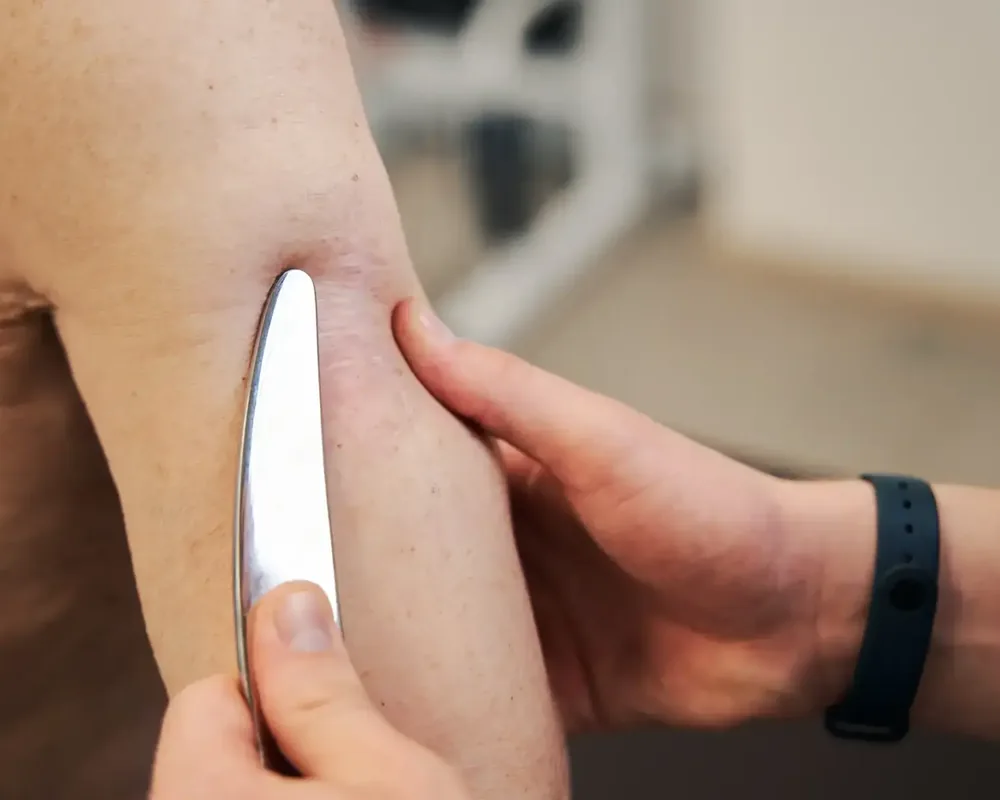 A category, not a brand
What It Helps
Instruments earn their keep on broad, superficial tissue that has been restricted for a while, and on regions simply too large to treat well by thumb. Where they come up most often:
Fascia does not tear or swell in any way that shows up on a scan, so a region can stay restricted for years while every image comes back clean. What you notice instead is your world shrinking by degrees: the stairs taken one at a time now, the reach that never quite finishes, the run cut to a walk at the same corner. Nobody books an appointment for that until something louder happens, and the louder thing is usually a compensation somewhere else finally giving out.
What A Session Looks Like
1
We choose the right instrument.
2
Map lightly, then treat the grit.
3
Spend the window on movement.
IASTM is done inside a regular visit. Your clinician picks an instrument shaped for the region, applies an emollient so the tool glides rather than drags, and passes it across the tissue at an angle: lightly first, to map what is restricted, then with more intent where the tool reported grit. Which instrument comes out is a decision about your tissue, not about which brand a clinic bought.
The sensation is a firm scraping that only feels uncomfortable over tissue that was already tender. The skin reddens and warms, occasionally with fine speckling that clears in a few days, and unlike cupping it does not reliably leave marks you can spot across a room. Blood thinners, easy bruising, skin conditions, and recent surgical sites all change what we do, so say so before we start. Then the visit moves on into movement and loading, because an instrument opens a window and the window is not the treatment.
Who It’s For
Broad, superficial restriction that has been the same for months.
Regions too large for a thumb: IT band, calf, forearm, thoracolumbar fascia.
An evaluation that has already named the tissue as the actual problem.
Someone who will spend the window on movement in the same visit.
IASTM suits a restriction that is broad, persistent, and reachable from the surface, and it suits it partway into a plan rather than at the front of one. It is also, bluntly, not a thing to shop for by name. It is a way of delivering pressure, and the pressure is only worth delivering if the evaluation says that tissue is the problem.
If you got here comparing IASTM to Graston to ART, trying to work out which one you should ask for, the good news is that you can stop. That choice belongs to the clinician and it gets made at your evaluation, in front of you, out loud. What is worth shopping for is somebody willing to tell you which tool your tissue needs, and willing to tell you when the answer is none of them.
It does not lengthen a muscle permanently, it does not dissolve scar tissue, and it does not correct a joint restriction; that one belongs to manual therapy. On its own it does nothing durable at all. An instrument pass that is not followed by loading buys roughly a day. It is also the wrong choice over an acute injury, a fresh surgical scar, or skin that is already compromised, and it reaches straight past a single deep trigger point that dry needling gets to in seconds.
Really friendly staff and very welcoming culture. They helped me figure out my problem and if was a very smooth process - highly recommend!
Pairs Well With
Each of these is a tool inside the plan. None of them is the plan.
Questions, Answered
Instrument-assisted soft tissue mobilization. It describes any technique where a clinician works muscle and fascia with a shaped tool, usually stainless steel or a hard polymer, instead of with their hands. It is a category rather than a product, and several branded systems live inside it.
The Graston Technique is a branded system of IASTM, with its own stainless steel instruments and its own certification course. IASTM is the category it belongs to. A clinic listing both as separate services is listing one thing under two names. What genuinely changes between instrument sets is shape, edge, and material, not the underlying idea.
IASTM puts a tool between the clinician and your skin, which concentrates pressure into a thin line of contact and covers broad regions without a hand fatiguing. Active Release Technique uses hands only and asks you to move the limb while a contact stays fixed, which lets it reach small, deep targets near a nerve that a tool has no safe way to treat. Different problems need different ones, and the evaluation decides which.
Most people tolerate it well, with temporary redness and occasional fine speckling that clears within a few days. It is not appropriate over an acute injury, an open or recent surgical wound, an active infection, or compromised skin, and it is used cautiously or not at all with blood thinners, clotting disorders, and anything that makes you bruise easily. Your Doctor of Physical Therapy screens for all of that before an instrument comes out of the drawer.
Book Your Visit
Five short questions. A real person from our front desk calls you back with times that fit your week. No phone tree, no ‘someone will reach out.’ Rather pick a slot yourself? Book online any time.
5.0 · 94 Google reviews
A real person calls you back during office hours
Step 1 of 5
That’s the hard part done. We’ll call during business hours to lock in your time.
Visit Us
Suite 203 on Cypress Creek Road in Cedar Park, open Monday to Friday from seven. Come see the place before you commit, if you like.