
1
We measure range and strength.
Rehabilitation for bones, joints, muscles, and tendons after an injury or a diagnosis: one-on-one with a Doctor of Physical Therapy, loaded to what the tissue can take, finished on an endpoint you agreed to.
What It Is
Orthopedic therapy is the care line for the musculoskeletal system: bone, joint, muscle, tendon, and ligament. It is where you land when there is an injury or a diagnosis with a name attached. A rolled ankle that never fully settled. A rotator cuff the imaging called frayed. An arthritic knee. A wrist that healed after a fracture but still will not turn a doorknob comfortably.
Because the structure is known, the plan can be built around what that tissue tolerates now and what it should tolerate later. Tendon behaves differently than ligament, which behaves differently than a joint capsule that has been immobilized, and a doctorate-level evaluation is what tells those apart in your specific case. All four of our treating clinicians hold a DPT, so the reasoning behind your dosage gets explained rather than assumed.
The four phases still run in order, Pain, Prime, Perform, and Prevent, and the work still finishes. What orthopedic therapy adds is precision about the tissue: how much load, how often, and what has to be true before the next step is safe. That is also why the endpoint is nameable at your evaluation instead of open-ended.
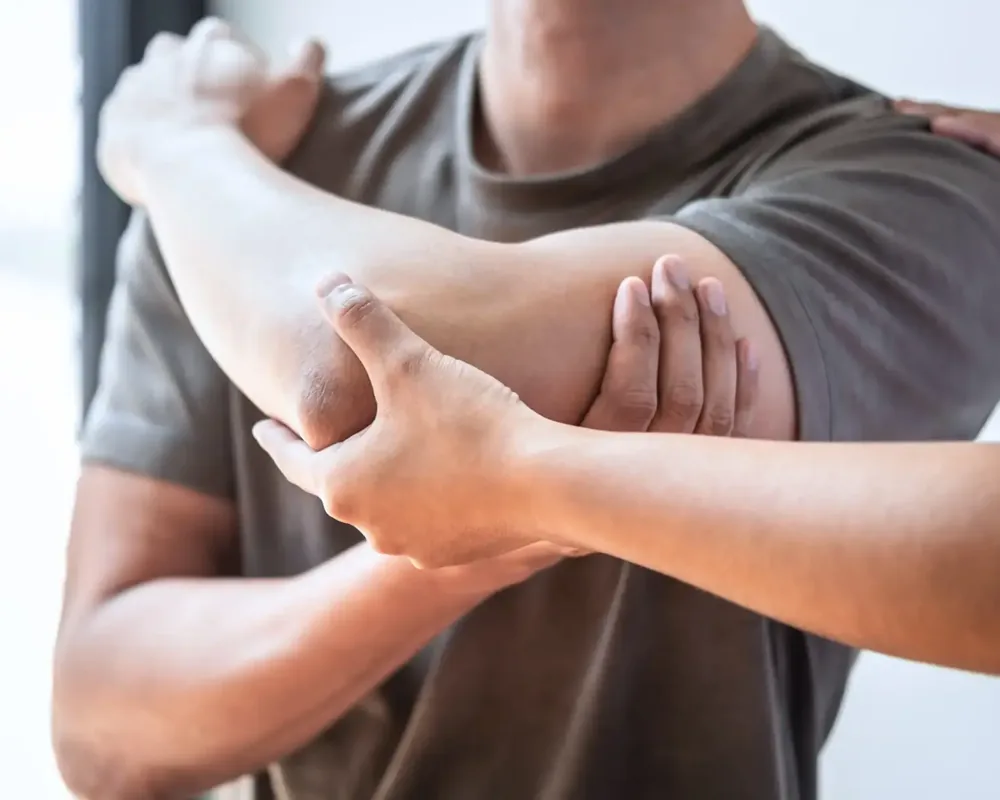 Loaded to what the tissue can take
What It Helps
Sprains and strains, tendon problems, arthritic joints, and the long tail after a fracture or a procedure. A sample of what it commonly addresses:
An injured joint that never finishes rehab does not go back to neutral. It keeps the limp, the guard, or the half inch of missing motion, and the body reorganizes around that shortfall until the complaint you book for a year later is somewhere else entirely.
What A Session Looks Like
1
We measure range and strength.
2
Hands-on where it’s stuck.
3
Load dosed to the tissue.
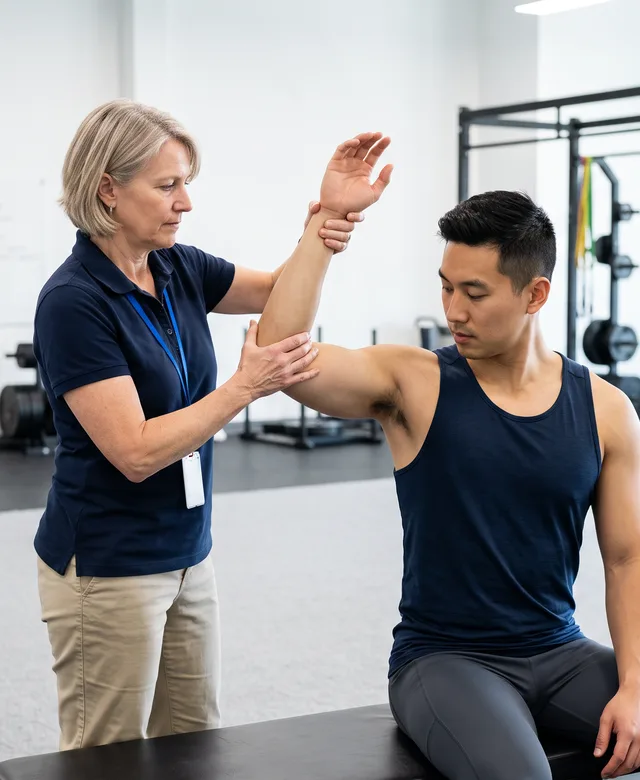
The evaluation is 40 minutes of specifics: what happened, what the imaging or the surgeon said if there is any, then measured range, strength tested side against side, and the joints above and below checked for what they have been covering. You leave with the diagnosis explained in mechanical terms, the plan named, and treatment already started.
Follow-up visits open with the numbers. Range compared to last week, strength compared to the other limb, and what your week actually asked of the joint. Then hands-on work where the restriction is, then loading dosed to the tissue, with your Doctor of Physical Therapy in the room adjusting as it goes. Progress here is something you can see on paper, which is also what tells us when you are done.
The experience was excellent and the PT’s assessment and recommendations for my ailments lead me to believe that my condition could/would be improved with my commitment to the exercises prescribed.
How It Fits Your Plan
Calm it down.
Settle the irritated tissue and unload it enough to move, without parking the joint in a sling for a month.
Restore what’s stuck.
Range first: the glide and the tissue length the injury or the immobilization took away.
Build strength you trust.
Progressive load dosed to the tissue, compared side to side, until the injured limb stops being the weak one.
Make it stay fixed.
Testing before you’re cleared, then a short program that protects the joint at work and on the weekend. Then we graduate you.
Orthopedic therapy fits the person with an injury or a diagnosis and no clear next step: told to rest and it did not resolve, handed a sheet of exercises with no progression, or cleared by a physician with a vague instruction to strengthen it. It also fits the person whose scan named something ominous and who now moves carefully around a word they did not fully understand.
If you brought your imaging report to this page and read it twice, that is not health anxiety. That is a reasonable person wanting the mechanical explanation nobody had ten minutes to give you.
Pairs Well With
These are tools inside one plan, chosen for your tissue and your timeline, not stacked on to fill 40 minutes.
Questions, Answered
It is the same one-on-one visit with a Doctor of Physical Therapy, aimed at a named structure. Orthopedic therapy starts from an injury or a diagnosis, a strain, a tendinopathy, a fracture that has healed, an arthritic joint, and builds the plan around what that tissue can tolerate now and what it should tolerate by the end of the plan. General physical therapy asks what is wrong. Orthopedic therapy usually already knows, and asks how much load it is ready for.
No. Bring the images if you have them, because they narrow the question, but you do not need imaging to start and you do not need a referral. Texas Direct Access means you can book the evaluation yourself. If your exam turns up something that belongs in a physician’s hands first, we tell you that day rather than treating around it.
It helps, and the reason is mechanical. Cartilage changes are not reversible, but most of what makes an arthritic joint hurt day to day is the stiffness, the weak muscle around it, and the way you have started loading it since it got sore. All three of those move. Change them and the joint behaves differently on the stairs and at night, even though the film still looks exactly the same.
Earlier than most people do, once anything urgent has been ruled out. The first weeks are when the tissue is deciding how it will heal and when guarding habits are cheapest to undo. Waiting to see whether it settles on its own usually means arriving with two problems: the original injury, plus the limp, the guard, or the borrowed motion that grew around it.
Book Your Visit
Five short questions. A real person from our front desk calls you back with times that fit your week. No phone tree, no ‘someone will reach out.’ Rather pick a slot yourself? Book online any time.
5.0 · 94 Google reviews
A real person calls you back during office hours
Step 1 of 5
That’s the hard part done. We’ll call during business hours to lock in your time.
Visit Us
Suite 203 on Cypress Creek Road in Cedar Park, open Monday to Friday from seven. Come see the place before you commit, if you like.