
Phase I
Pain
Make the next month safer.
Whatever is most dangerous, first: the dizziness, the joint that hurts enough to change your walk, the rug at the top of the stairs. Plus a straight answer about anything that belongs with your physician.
What We Treat
Unsteadiness rarely announces itself with a fall first. It starts with a hand on the wall and an errand quietly dropped. A cause-first evaluation finds out which system is actually failing, then a plan with an endpoint gives you back the walk, the curb, and the week.
Sound Familiar?
Nobody walks in describing a postural control deficit. They describe the hallway. Pick the ones that sound like your week, or like your parent’s.
Two or more? That’s not old age. Keep reading.
If you’re reading this for a parent who insists nothing is wrong, that isn’t hovering. You’ve noticed the thing they’ve started quietly organizing their week around.
Why It Happens
Staying upright is three streams of information and one fast set of reactions. Trouble anywhere along that line shows up as the same symptom. Strength and speed at the hip and ankle. Catching yourself is a power test: a foot has to arrive somewhere in a fraction of a second. That capacity fades earlier than people expect, and it’s the most trainable item on this list.
The inner ear. A vestibular system that misreports head movement makes turning, rolling over in bed, and looking up feel unreliable; our vestibular therapy page covers that side. Sensation in the feet. Neuropathy takes away the floor, which is why dusk and unfamiliar rooms are where things go wrong. A joint that hurts. A painful hip or knee changes the walking pattern long before anyone calls it a gait problem.
Neurological conditions. Parkinson’s disease, stroke, multiple sclerosis, and the lingering effects of a concussion each change balance in their own way. Medication, blood pressure, and vision are common and real, and not ours to manage: if the evaluation points there, we send you to the right person.
Then there’s caution. A person who has fallen once walks differently on purpose, does less, gets weaker, and becomes more likely to fall again. That loop shrinks a week fastest, and it turns around soonest.
The Honest Truth
Left alone: fewer errands, less walking, less strength, and a smaller circle of places that still feel possible. The week shrinks by one thing at a time, and almost nobody notices until the list is short.
Near misses are the best time to start, not a reason to wait for a fall.
How We Fix It
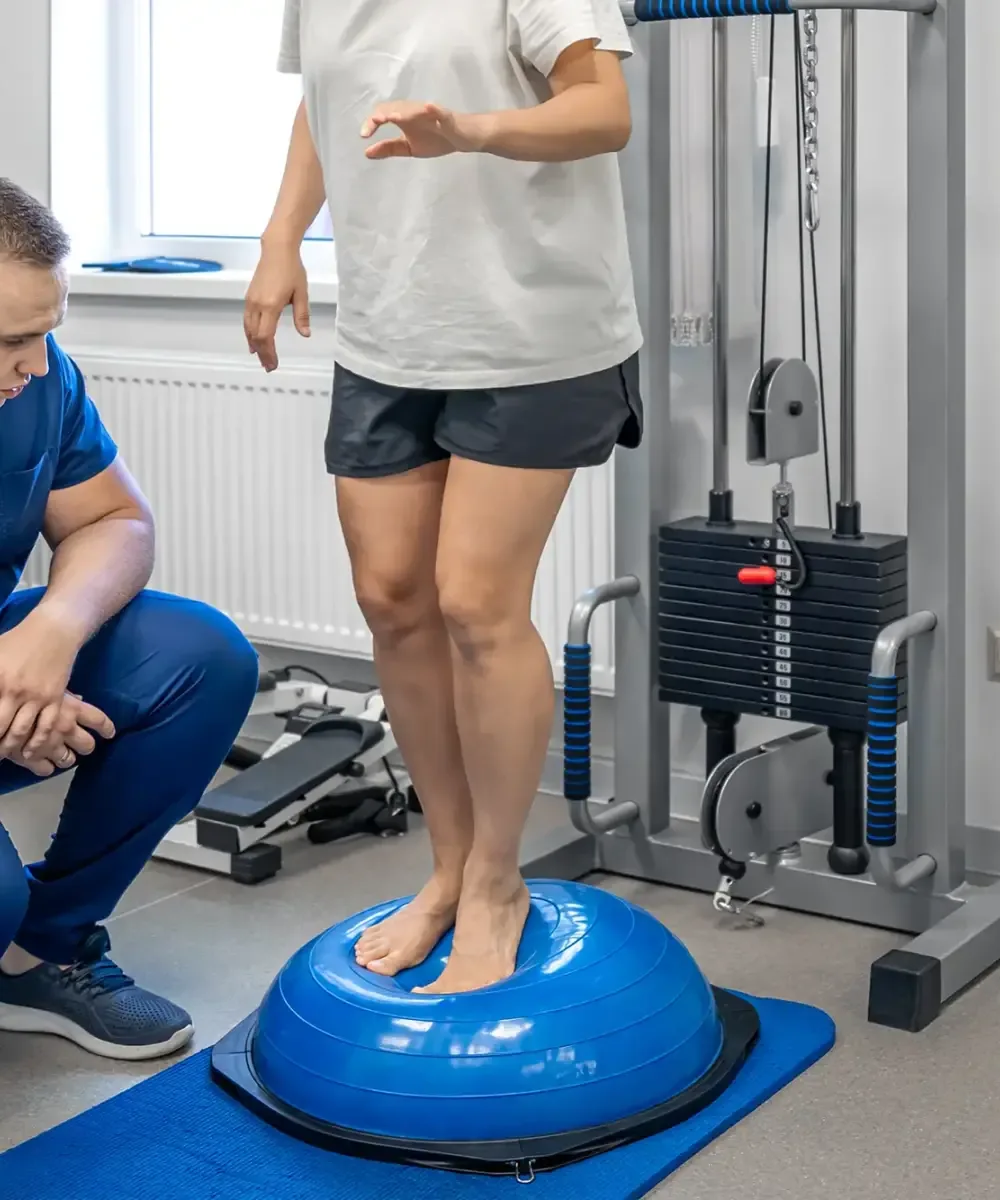
A cause-first evaluation, one-on-one with a Doctor of Physical Therapy: watching you walk and turn, testing hip and ankle strength, checking the inner ear and eyes together, and finding out what the feet can still feel. The endpoint is a task, not a feeling: the grocery store, the church parking lot, a grandchild’s hand on a busy sidewalk.
Phase I
Pain
Whatever is most dangerous, first: the dizziness, the joint that hurts enough to change your walk, the rug at the top of the stairs. Plus a straight answer about anything that belongs with your physician.
Phase II
Prime
Ankle and hip range, upright posture, and gaze work so your head can move without the room moving with it. Small pieces, but every later step is built on them.
Phase III
Perform
Getting out of a chair without hands. Standing on one leg long enough to pull a sock on. Stepping fast enough to catch yourself, trained on purpose rather than left to luck.
Phase IV
Prevent
The real world added back deliberately: uneven grass, curbs, low light, a bag in one hand, someone talking to you. Then a home program short enough that you’ll actually run it.
They are mindful of my needs and limitations and are willing to work around them. My therapist is kind, understanding and encouraging.
Janice W. · Google review
Questions, Answered
Getting older is not a diagnosis, and it is not a treatment plan either. Age raises the odds, but the things actually making someone unsteady are usually specific and testable: hip and ankle strength, how fast the body can put a foot down to catch itself, an inner ear that is misreporting, sensation in the feet, vision, or a joint that hurts enough to change the walking pattern. Most of those respond to training. None of them respond to waiting.
It is the best time to come in. The people who do best here are the ones who show up with near misses rather than fractures: holding the wall, taking stairs one at a time, skipping the uneven parking lot. Those are all early reports from the same system, and they are far easier to work with before a fall has added fear and a few weeks of sitting to the problem.
Then we say so and point you to the right person. Balance problems sometimes trace back to medication, blood pressure, an inner ear condition, vision, or a neurological diagnosis, and none of those are ours to manage. The evaluation is built to sort what physical therapy can change from what needs a physician, and you will get a straight answer either way rather than a course of visits that quietly avoids the question.
Not usually, and that is a decision, not a fate. Some people are safer with a cane or a walker for a stretch while strength and reactions are being rebuilt, and some people need one permanently. Plenty of others simply need the strength and the stepping reactions back. What we will not do is hand you a device instead of an evaluation, or take one away from you because it looks better without it.
Book Your Visit
Five short questions. A real person from our front desk calls you back with times that fit your week. No phone tree, no ‘someone will reach out.’ Rather pick a slot yourself? Book online any time.
5.0 · 94 Google reviews
A real person calls you back during office hours
Step 1 of 5
That’s the hard part done. We’ll call during business hours to lock in your time.
Visit Us
Suite 203 on Cypress Creek Road in Cedar Park, open Monday to Friday from seven. Come see the place before you commit, if you like.