
Phase I
Pain
Calm it down.
Easing pelvic, back, or scar pain first, with hands-on care and comfortable positions for feeding, lifting, and sleep.
What We Treat
Your body did something enormous, and the six-week check-up is not the finish line. A one-on-one evaluation with a Doctor of Physical Therapy finds what still is not working, from leaking and pelvic pain to a core that feels disconnected, then a plan with an endpoint gets you lifting, running, and moving with confidence again.
In Your Words
If two or three of those sound like your days, you’re not being dramatic and it is not just part of being a mom now. These are common after pregnancy and delivery, and they are treatable.
Why It Happens
Pregnancy and delivery change a lot at once, and the body does not always reorganize itself on its own. What we usually find, alone or in combination:
None of this means something is wrong with you. It means your body needs a structured return, the same way an athlete coming back from an injury would get one.
Getting Better
Many new moms are told that leaking, pelvic heaviness, and a weak core are just part of life after a baby. They are common, but they are not something you have to live with. Most people call us after months of planning around their symptoms: skipping the trampoline, crossing their legs before a sneeze, or putting off getting back to the gym.
Progress shows up in everyday moments first: a sneeze that passes without a second thought, a full day of carrying your baby without your back complaining, a first easy run that feels solid. If pelvic pain or leaking is your main concern, our pelvic floor therapy page covers that care in more detail.
Postpartum symptoms do not have a deadline. Whether your baby is six weeks old or six years old, the pelvic floor and core can still be retrained.
How We Treat It
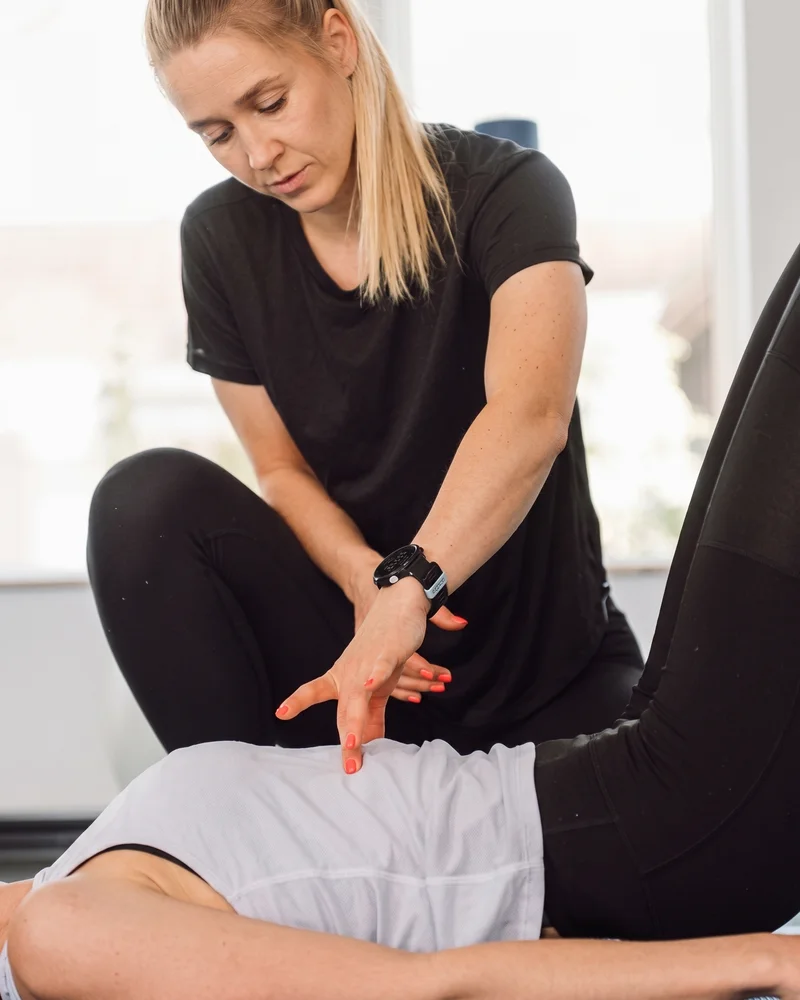
Care starts with a private, one-on-one evaluation with a Doctor of Physical Therapy: how your pelvic floor and core are working together, how your back and hips are handling the load of caring for a baby, and what you want to get back to. From there, care moves through four named phases.
The plan’s endpoint is named at your evaluation and reviewed with you every phase, because the goal is to get you back to your week, not to keep you on the schedule.
Phase I
Pain
Easing pelvic, back, or scar pain first, with hands-on care and comfortable positions for feeding, lifting, and sleep.
Phase II
Prime
Reconnecting breath, core, and pelvic floor so they work as a team again, and restoring movement around any scar tissue.
Phase III
Perform
Progressive core, hip, and pelvic floor strengthening matched to your real life, from lifting the car seat to carrying a toddler on one hip.
Phase IV
Prevent
A clear return to running, lifting, or classes, tested before you’re cleared, plus a short home program you can keep doing.
I worked with Dr Burrow for postpartum pelvic floor therapy. She is professional, knowledgeable and such a joy to hangout with during my PT sessions! The entire staff is friendly, personable and truly wonderful people. Thank y’all so much for everything.
Daniela C. · Google review
Questions, Answered
Many people start around their six-week check-up, once their provider has cleared them, and some begin gentle work sooner. There is no deadline on the other end. Leaking, pelvic pain, or a weak core can be treated months or years after delivery, so it is never too late to come in.
No referral is needed. Texas Direct Access means you can book a physical therapy evaluation without a physician’s note first. If anything in your evaluation suggests you should see your OB or midwife, we will tell you and help coordinate.
It is common, but it is not something you have to accept. Leaking with a cough, sneeze, laugh, or jump usually means the pelvic floor is not reacting quickly or strongly enough yet, and that responds well to targeted training.
Your first visit is 40 minutes, one-on-one with a Doctor of Physical Therapy, in a private setting. We talk through your pregnancy, delivery, and symptoms, look at how your core, hips, and back are moving, and assess the pelvic floor only with your consent. You leave with a plan and a few things to start on at home.
Book Your Visit
Five short questions. A real person from our front desk calls you back with times that fit your week. No phone tree, no ‘someone will reach out.’ Rather pick a slot yourself? Book online any time.
5.0 · 94 Google reviews
A real person calls you back during office hours
Step 1 of 5
That’s the hard part done. We’ll call during business hours to lock in your time.
Visit Us
Suite 203 on Cypress Creek Road in Cedar Park, open Monday to Friday from seven. Come see the place before you commit, if you like.